A calculus of session review.
A good session replay holds the user's trajectory: every click, navigation, network request, and console log. But dumping all of it into an agent's context window puts stress on attention. What's the important signal? Is repeated data meaningful? Are these errors impacting the user experience or just noise? Agents are great at summarizing data sets, but not at deciding what to summarize.
Session review needs a calculus: a pattern of progressive disclosure for revealing what happened. Every question an agent asks reduces to two moves: map the experience, then zoom into the details. Since each question maps to a specific set of tools, any query becomes a formula the agent can reuse.
Two data sets to review
A session review happens over two data sets: a signal stream and visual snapshots.
A signal stream is everything that happened, in order and when: the user's interactions, the navigations between pages, the network requests, and the browser console. Anything that failed is also flagged as an error.
A snapshot is the pixels at any instant, plus a text snapshot of the on-screen elements.
An agent reviews across both data sets: it zooms through the signal stream, or views snapshots and pixels at specific moments. We use zoom for the motion of attention: zoom in for more detail, zoom out for context. Every zoom call costs tokens, so the agent budgets attention by controlling how much resolution is returned.
Let's open the session and follow the agent's moves.
Interactive: click to explore each figure below.
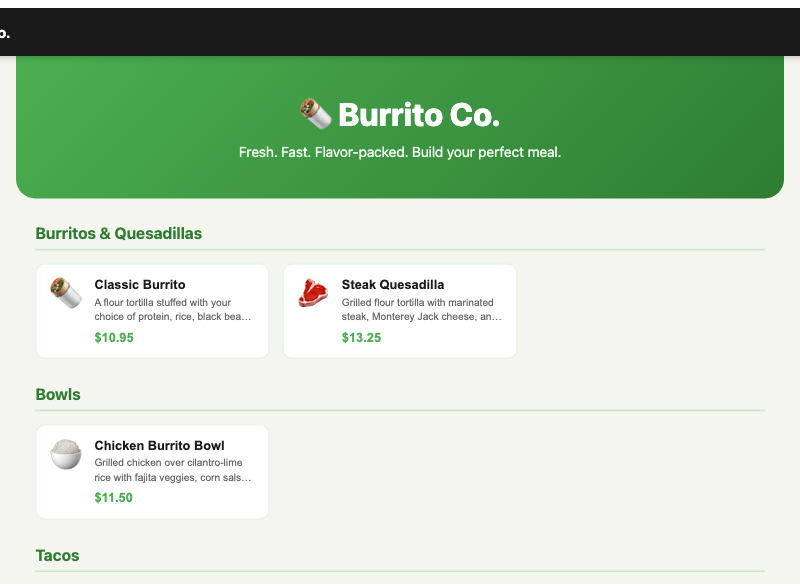
lens and the text snapshot grows to 12 elements, everything on screen.The map: always the entry point
Before an agent can zoom anywhere in the signal stream to answer a question, it needs to orient itself to where the data is clustered. Opening the session hands the agent a map and a digest: the user's flow through the app, counts of everything captured, and the signals rolled up at each stop.
Open the session and this is what comes back:
1## Map · 32 events · 0.0s–47s · 1 page(s)
2flow: /apps/burrito/ ▸ /item/ ▸ /cart/ ▸ /apps/burrito/ ▸ /item/ ▸ /cart/ ▸ /checkout/ ▸ /confirmation/
3phases:
4  /apps/burrito/[2]
5  -> /item/?id=classic-burrito[4]
6  -> /cart/[2]
7  -> /apps/burrito/[2]
8  -> /item/?id=chips-guac[2]
9  -> /cart/[2]
10  -> /checkout/[16]
11  -> /confirmation/[2]
12kinds:
13  navigation   8
14  interaction 19
15  network      3 (2 err)
16  console      2 (2 err)
17tags:
18  error:4
19
20# /apps/burrito/ (opened)
21page-load ×1 · interaction ×1
22
23# /item/?id=classic-burrito (navigated)
24interaction ×3
25
26# /cart/ (navigated)
27interaction ×1
28
29# /apps/burrito/ (navigated)
30interaction ×1
31
32# /item/?id=chips-guac (navigated)
33interaction ×1
34
35# /cart/ (navigated)
36interaction ×1
37
38# /checkout/ (navigated)
39interaction ×11 · network ×2 (2 err) ("POST /api/checkout") · console ×2 (2 err)
40
41# /confirmation/ (navigated)
42network ×1 ("POST /api/checkout")
43
44# /confirmation/ (closed)
The map orients the agent; the digest shows the signals cluster at checkout, where all four errors are.
How to take a closer look
With the map in hand, the agent can request more data, in greater detail, at any point in the session.
Any signal can be shown to the agent at one of four grains, coarse to fine:
-
digest
one line per kind, like
network ×3 (2 err)~60 tokens - standard the readable transcript, benign repeats merged ~460 tokens
- machine every signal, nothing merged ~530 tokens
- detail every signal plus its payload: headers, bodies, stack traces ~760 tokens
Visual snapshots have their own dial as well, a lens, that controls which elements come back in the text snapshot; this doesn't affect the pixels.
- interactive only what you can act on: buttons, inputs, links (5 elements) ~30 tokens
- visible everything on screen (12 elements) ~120 tokens
- full every element, plus CSS selectors (15 elements) ~370 tokens
Each snapshot in this post is shown with both the pixels and the text snapshot. The lens dial decides how much of that text snapshot comes back to manage tokens; the pixels never change.
Naming what to look at
An agent asks for signals by naming which ones it wants and in how much detail. For example {network: "machine"} means every network signal, over a time period, with no rollups.
Names for signals can overlap. A failed request is both network and error, and when a signal matches two, the finer grain wins.
Answering a question
Now put the calculus to work on a real report. The agent picks up a ticket: "A shopper says checkout is broken and they couldn't place their order." To find out why, it asks four questions: what did they do, what went wrong, what did they see, and what did the network do?
Read ; as then. Every answer has the same shape: first, then a .
What happened?
Where the user went and what they did.
# /apps/burrito/ (opened)
3120ms  click "🌯 Classic Burrito"
6480ms  click "steak"
8210ms  click "guacamole (+$2)"
10360ms click "Add 1 to Cart"
13840ms click "Continue Shopping"
# … Chips & Guacamole added …
# /checkout/
25640ms click "Continue to Payment →"
28080ms change card "•••• 0000"
        click "Continue to Review →"  (×3)
        click "Place Order · $17.17"  (×3)
        click "Try Again"             (×2)
42880ms change card "•••• 4242"navigation, interaction → grain), coarser to finer: readable, repeats merged.This whole visit is readable to the agent as a story: the user browses, customizes, adds to cart, checks out, and a retry that hints something failed.
What went wrong?
View just errors at the finest grain across the whole session.
It lands on the two declines, full failing payload, nothing else:
# /checkout/
33269ms POST /api/checkout => 402 (149ms)
    req-headers: content-type: application/json
    req:  { card_last_four: "0000", total: 17.17 }
    rsp-headers: content-type: application/json · content-length: 125
    rsp:  { error: "card_declined", code: "do_not_honor", card_last_four: "0000", message: "The card issuer declined the transaction." }
33270ms console.error "checkout declined: 402 do_not_honor"
38159ms POST /api/checkout => 402 (144ms)
    req-headers: content-type: application/json
    req:  { card_last_four: "0000", total: 17.17 }
    rsp-headers: content-type: application/json · content-length: 125
    rsp:  { error: "card_declined", code: "do_not_honor", card_last_four: "0000", message: "The card issuer declined the transaction." }
38160ms console.error "checkout declined: 402 do_not_honor"error → grain), coarser to finer: every signal, plus its payload.The agent sees two failures out of thirty-two signals: the card was declined twice, same card both times.
What did they see?
The stream says what happened; pair it with a snapshot at each moment and you also see what the shopper saw.
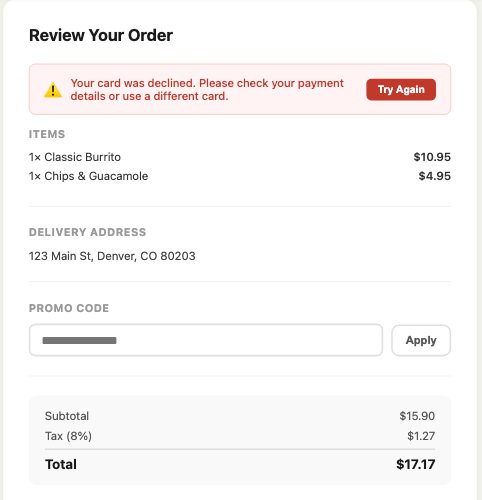
lens and the text snapshot grows to 12 elements, everything on screen.Next the user swaps in a good card and the order goes through.
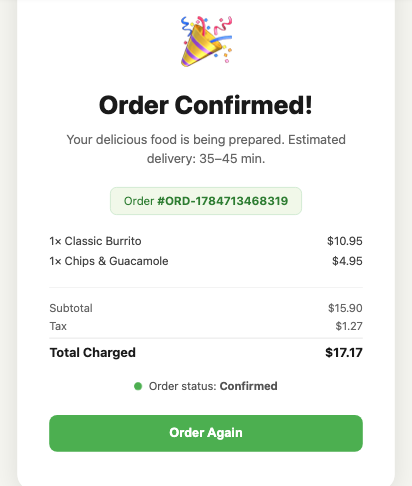
lens and the text snapshot grows to 9 elements, everything on screen.Devtools
The whole network and console picture across the session, one line per request and log.
This is where the successful retry shows up alongside the two declines. Zoom any request to detail for its full headers and body.
# /checkout/
33269ms POST /api/checkout => 402 (149ms)
33270ms console.error "checkout declined: 402 do_not_honor"
38159ms POST /api/checkout => 402 (144ms)
38160ms console.error "checkout declined: 402 do_not_honor"
# /confirmation/
46540ms POST /api/checkout => 200 (150ms)network, console → grain), coarser to finer: every signal, nothing merged.Attention is a zoom
Every question and answer above has the same shape. We start with a map (cheap and whole) and then zoom into signals or pixels to understand the root cause.
Try it on your own session.
1npx @subtextdev/subtext-wizard